How much to charge per post: an influencer rate card for 2026
Why the published rate guides disagree by 10x, the ranges I would actually use, the add-ons you are giving away for free, and how to hold your price when a brand pushes.
"What are your rates?" is the email most creators dread, because the honest answer is "I don't know, what were you going to offer?" That's how you end up doing three Reels and a Story set for $200 and a discount code. A rate card fixes it. Not because the numbers on it are sacred, but because you walk into every negotiation with a starting point you decided on when nobody was pressuring you.
This is how to build one: what the published benchmarks actually say (and why they contradict each other), what moves your number, the add-ons most creators give away for free, how to write the card, and how to hold your price when a brand pushes.
One warning before any figures. Everything below is in US dollars and is a range, not a price. Rates vary enormously by niche, audience location and how good your content is. Use the numbers to sanity-check yourself, then price for your own situation.
Why every guide gives you a different number
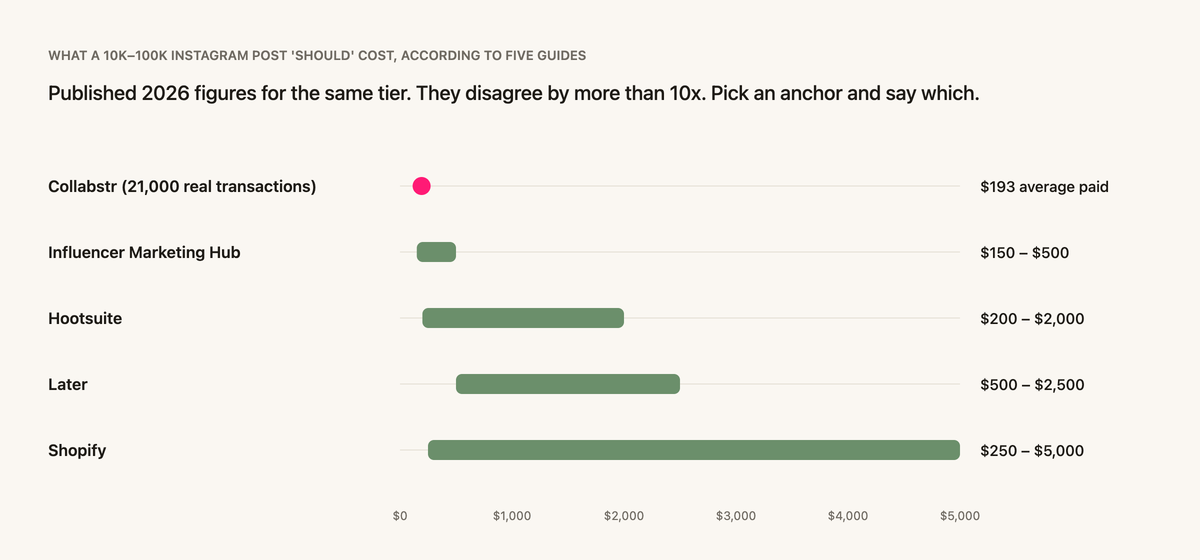
Search "influencer rates" and you'll find five reputable guides that disagree by more than ten times for the same tier. Here's what a single Instagram post from a 10k–100k account "should" cost, according to sources published this year:
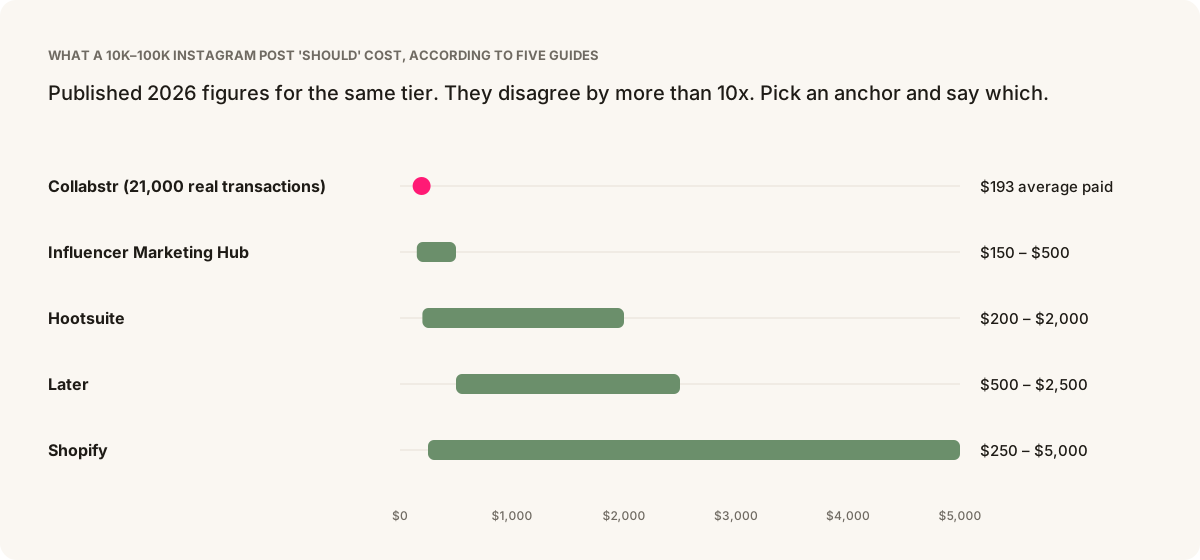
The reason is simple once you see it. Collabstr's $193 is the average actually paid across 21,000 marketplace collaborations, and nearly 80% of those cost under $300. The others are editorial ranges from Influencer Marketing Hub, Hootsuite, Later and Shopify with no disclosed methodology. Go the other way and IZEA's last large dataset (2022, $70M in payments, skewed to enterprise deals) had nano creators averaging $1,105 per post.
So: marketplace deals are cheap, direct deals with brands that have real budgets pay several times more, and the guides are somewhere in between. Pick which market you're pricing for and say so. Your rate card is for direct deals. Marketplace listings are a separate, lower number.
Starting ranges we'd actually use
These blend the sources above, weighted toward direct deals. Per single piece of content, English-speaking audience, no usage rights beyond organic posting.
| Followers | Instagram Reel | Instagram feed post | TikTok video | YouTube integration (60–90s) |
|---|---|---|---|---|
| 1k–10k | $75–$300 | $50–$200 | $50–$250 | $150–$600 |
| 10k–50k | $300–$1,200 | $200–$800 | $200–$1,000 | $500–$2,500 |
| 50k–200k | $1,200–$4,000 | $800–$3,000 | $1,000–$3,500 | $2,000–$8,000 |
| 200k–1M | $4,000–$15,000 | $3,000–$10,000 | $3,500–$12,000 | $8,000–$30,000 |
Format multipliers, from the same guides: Reels price at 1.2 to 1.5 times a static post (Influencer Marketing Hub) or 20–30% above (Later). Stories are 30–50% of a feed post, sold in bundles of three to five frames. A dedicated YouTube video, where the whole thing is about the product, runs 1.3 to 1.5 times an integration; a standalone Short is about half a long-form CPM. Newsletter mentions, podcast reads and livestream segments are priced case by case and are often better value per viewer than any of the above.
If you're at the small end, take the marketplace reality seriously. At 15k followers with average engagement, $250–$400 for a Reel from a brand with a budget is a good outcome. Don't refuse it because a guide said $2,500.
The $100 per 10k followers rule
You'll hear this constantly. It's a sanity check, not a price. Nobody can trace where it came from; Neal Schaffer, who has tested every rate calculator going, calls it exactly that. Modash quotes a version that's ten times higher, $100 per 1,000 followers. And it ignores everything that actually sets a price: format, niche, engagement, usage, platform. Use it to notice if you're wildly off. Then ignore it.
What moves your number
Engagement
The biggest lever. HypeAuditor's 2025 data has Instagram nano accounts at 2.19% engagement (interactions over followers), the highest of any tier, and TikTok nano at 11.9%. Influencer Marketing Hub puts micro at roughly 3.86% and macro around 2.05%. If you're well above the benchmark for your size, price at the top of the band or above it, and say why in the pitch. Brands pay for audiences that act, and small accounts have the numbers to prove theirs do. Just state your formula; the same account can be 1.78% or 7.9% depending on whether you divide by followers or views.
Niche
Collabstr's transaction data shows the spread: beauty averages $210 per collaboration, fashion $217, business $295, education $307, skilled trades $309. On YouTube it's starker. OutlierKit's integration CPMs run $40–$80 for B2B software, $30–$60 for personal finance, $25–$45 for tech, and $15–$25 for lifestyle. A 20k personal-finance account can out-earn a 200k meme account, because the customer behind it is worth more.
Where your audience is
A US, UK, Canadian, Australian or Western European audience prices higher than the same follower count elsewhere, because that's where the budgets point. Favikon's 2026 B2B pricing data has the median sponsored post at $500 in the US, $550 in the UK, $300 in France and $155 in India. Know your top three countries and put them on your page and your card.
Proof
If you can show a past campaign's results, taps, signups, sales, you're no longer selling views. You're selling outcomes, and outcomes are priced on a different scale. This is why reporting after every deal matters, and why the creators who do it charge more.
The add-ons you're giving away
The post is the base price. Everything a brand asks for on top is extra, and brands expect to pay for it if you ask. Most creators don't ask.
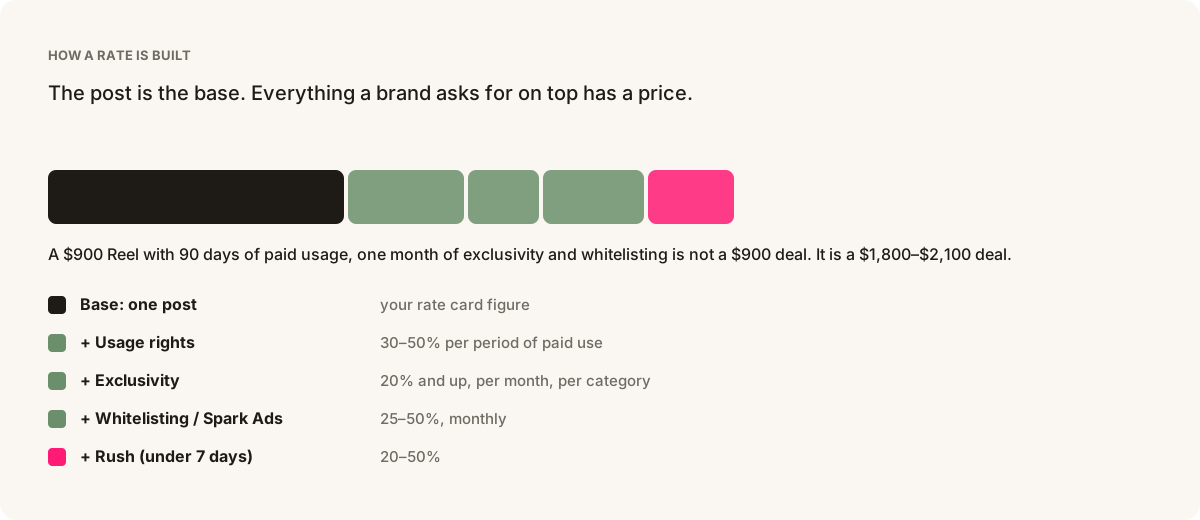
- Usage rights. If the brand wants to run your video as a paid ad or on their own channels, that's a licence. Later benchmarks it at 30–50% on top of the base rate; Influencer Marketing Hub says 30% to more than 100%; Collabstr's data shows usage rights raising the price by up to 39% in practice. And it's not a niche request: Aspire found 77% of brands repurpose creator content in ads and 67% try to bake usage rights into the initial contract. Price it per period, and make the clock start on the first day of use, not the day you deliver. Never give perpetual, worldwide, all-media rights away for free. That's the most valuable thing in the deal.
- Exclusivity. Not posting for competitors for a period. Influencer Marketing Hub puts it at 20% to more than 100% depending on how much of your niche the category covers. Charge per month, and define the category narrowly.
- Whitelisting and Spark Ads. Letting the brand run ads from your account. Later says 30–50%; agency guides cluster around 25–50% for 30 days, with TikTok Spark Ads carrying a premium. Monthly, always.
- Rush. Under a week's notice: 20–50% on top.
- Revisions. One round included. More is billable.
- Link in bio and Story links. Small, but brands ask. Bundle or charge a token amount.
Put those together and a $900 Reel with 90 days of paid usage, a month of category exclusivity and whitelisting is not a $900 deal. It's roughly $1,800–$2,100. If you only quote the $900, you've just paid the brand $1,000 for the privilege of working with them.
How to write the card
One page. Your name and handle. Follower counts per platform with a date. One line on who your audience is. Then a short table: format, "starting at" price, what's included by default (one revision round, 30 days organic usage, a Story link). Below it, one line: "Paid usage, exclusivity, whitelisting and rush priced per brief." Below that, a link to your page with live numbers and past work. Done.
"Starting at" is the important phrase. It gives you room to go up for a big brand and to package things for a small one without contradicting yourself.
Rates on your public page, or not
Reasonable creators disagree. Public rates filter out brands with no budget and save you a lot of email. Private rates let you price per brief and avoid anchoring low. The data leans slightly toward keeping them out of the first contact: PitchBrand's analysis of 29,000 pitches found mentioning rates in the initial email slightly reduced replies. Our middle path: "starting at" figures on the card, sent on request; public page focused on numbers and past work. If a brand asks for rates before saying anything about the brief, reply with the card and one question: what's the campaign and what's the budget range?
Holding your price
Brands negotiate. Know their playbook and it's much less stressful.
The brand-side guides are candid. InfluencerFee's negotiation playbook tells brands to target 15–30% below a creator's ask for a single post, up to 35% for multi-post packages, and notes that going below 40% of the ask "rarely succeeds". The lever they're taught to pull is volume: three posts for a 15–20% per-post discount, six for 20–30%, a twelve-month ambassador deal for 30–40%. That's not unreasonable, and the package can be good for you too. The Influencer Marketing Factory's 2026 data found the longest brand partnerships belonged to small Instagram creators, and 71% of creators already discount for longer commitments.
So when a brand comes back lower, don't just drop the number. Take something out. Fewer deliverables, shorter usage, no exclusivity. "I can do $600 instead of $900 if we drop the Stories and keep usage to 30 days" keeps your rate intact and teaches the brand your extras have value. If they want the discount, offer the package: "$800 per Reel for a three-Reel series" is a discount that gets you three deals.
And if a brand's budget is under half your rate with no package to justify it, say no. The deal you don't take is cheaper than the one that eats a week and pays $150.
Getting paid
A rate is only real if the money arrives. Some basics from Gigapay's guide and Digiday's reporting on creator payment terms:
- Brands typically pay 30 to 90 days after delivery. Net 30 happens maybe half the time; net 60 is common. Ask for net 30 or better. Big brands can't always change it, but they'll often do a 50/50 split: half on signing, half when the post goes live.
- Late payment is normal, not rare. A Tipalti survey found 56% of creators have faced late payments. Put a late fee in your terms (1.5% a week after a five-day grace period is one common structure) and send the invoice the day the post goes live.
- Have a kill fee. If the brand cancels after you've shot the content, you get paid for the work done.
- Have your tax form ready before they ask. Missing paperwork is the most common reason a payment stalls.
Update it every quarter
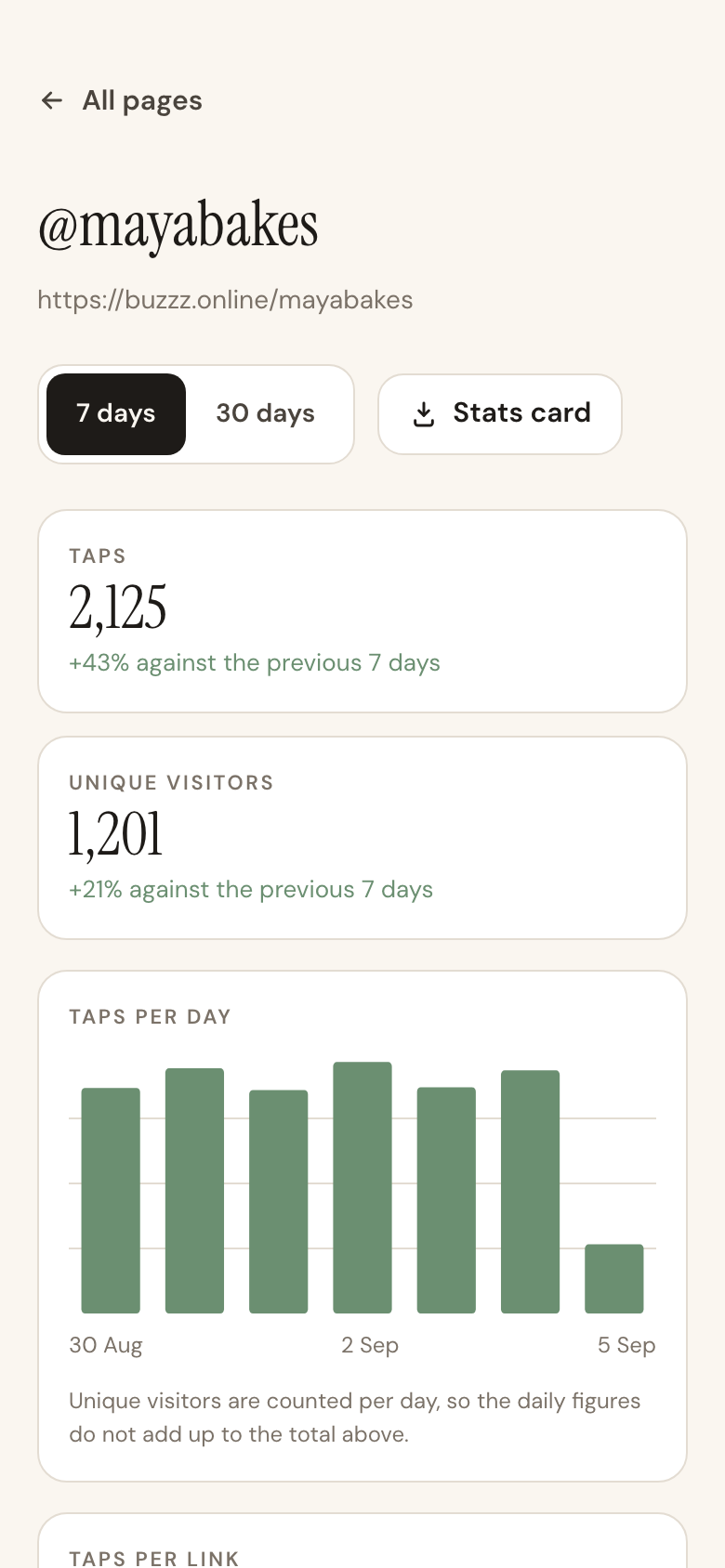
Your numbers change; so should your card. First week of each quarter: refresh your counts, look at what you actually closed at, move the ranges. If you closed every deal at your ask last quarter, you're too cheap. If you're using a page like Buzzzlinks, the follower counts and audience section update themselves, so the only thing you have to think about is the prices.
The creators who get paid properly are the ones who decided what they cost before a brand asked. Decide this week.