What goes in a creator media kit (with examples and 2026 benchmarks)
The eight things a brand looks for in a media kit, in the order they read it, backed by 2026 data. Plus what to cut and how often to refresh.
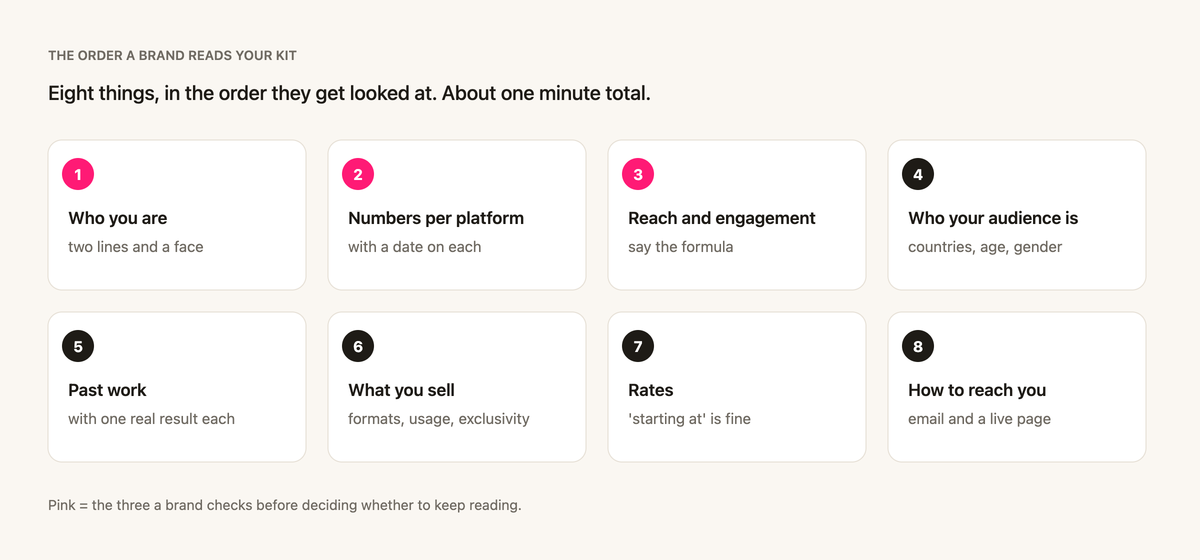
A brand manager opens a lot of media kits. Most are six-page PDFs: a mood board, a paragraph about "authentic storytelling", and follower numbers from whenever the creator last remembered to update them. The ones that get a reply answer three questions in under a minute. Who sees your content. What happens when you post. What it costs.
That's it. Everything below is about answering those three questions in the order a brand asks them, with numbers a brand can trust. We'll also show you what to cut, how often to refresh it, and why the PDF format is the thing quietly costing you deals.
What brands are actually looking at
Start with what the brand side says, not what creator blogs say.
CreatorIQ surveyed 5,095 creators for its State of Creators 2026 report and found something uncomfortable. Brands say they pick partners on "creator fit, engagement and performance". But follower count still has the strongest relationship with creator income across Instagram, TikTok and YouTube. Instagram follower count is the single strongest predictor of how much a creator earns. Brands buy on fit. They pay on reach.
The second thing brands care about is whether your reach is real. In Influencer Marketing Hub's 2026 Benchmark Report, fake or bot followers made up 56.5% of all fraud issues brands reported. Kolsquare's survey of 380 senior marketers found the top selection criteria were content style (50%) and authenticity (47%), and that measuring ROI was a pain point for half of them.
So the brand reading your kit is holding three worries at once: is the audience big enough, is it real, and will I be able to prove this worked to my boss. Your kit's job is to settle all three before they finish scrolling.
1. Who you are, in two lines
Name, handle, niche, where you're based, one sentence on what your content is for. "Weeknight cooking for people with 20 minutes and one pan" beats "lifestyle creator and storyteller" every time, because a brand can match it to a customer. Put your photo here. They're buying you; a face makes the rest easier to trust.
Keep the about section to two lines. Justin Moore of Creator Wizard, quoted in vidIQ's guide, says to take the about section everyone puts on page one and move it to the end. We'd go further: two lines up top, nothing else. Your story is not what they're evaluating.
2. Your numbers per platform, with a date on each
Followers or subscribers for each platform you'd actually deliver on. Not every account you own. If TikTok is 60k and YouTube is 400, YouTube doesn't go in.
Put a date next to every number. "128,400 followers, updated 6 September" reads as honest. A round number with no date reads as old, because it usually is. This is the part of your kit that goes stale fastest, and it's what brands check first. The brand-side audit guides agencies use to vet creators say data should be under 30 days old, and specifically flag screenshots as "easily manipulated" and lacking timestamps. Assume the person reading your kit has been trained to look for exactly that.
3. Reach and engagement, and say the formula
Followers are what everyone shows. Reach and engagement are what brands price on. For your main platform, over the last 30 days, give three things: average views per post, your engagement rate, and your best recent post with its numbers.
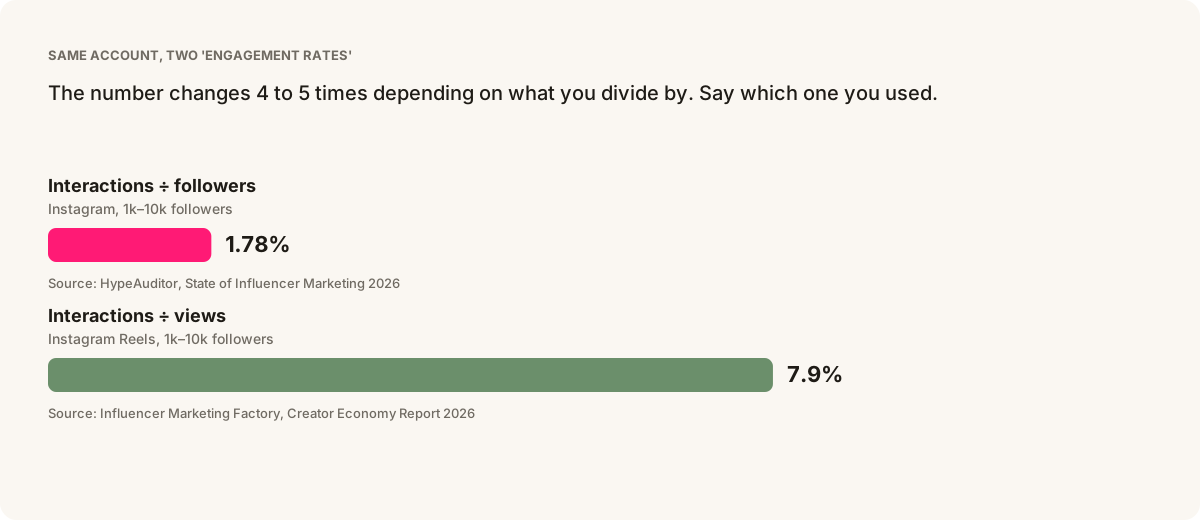
Here's the part almost every kit gets wrong. "Engagement rate" means nothing until you say what you divided by. Look at the spread in the published benchmarks:
- HypeAuditor's 2026 State of Influencer Marketing puts Instagram engagement at 1.78% for 1k–10k accounts, 0.54% for 10k–50k, and 0.33% for 1M+. That's interactions divided by followers.
- The Influencer Marketing Factory's 2026 Creator Economy Report puts Instagram Reels engagement at 7.9% for the same 1k–10k tier, and TikTok at 8.1%. That's interactions divided by views.
- HypeAuditor's 2025 report had TikTok nano accounts at 11.9% and Instagram nano at 2.19%.
Same kind of account, a five-times difference, purely from the denominator. If you write "6% engagement" with no formula, a brand comparing you against a follower-based benchmark thinks you're lying, and a brand comparing you against a view-based benchmark thinks you're average. Write the formula: "(likes + comments + saves + shares) ÷ reach, last 30 days". Then the number means something.
One more thing on this. Small accounts win here, and the data is on your side. Nano accounts on TikTok are running interaction rates above 10%; mega accounts on Instagram are under 1%. If your engagement is strong, this section is where you beat the 500k account the brand was also considering. Make it impossible to miss.
4. Who your audience is
Three things, pulled straight from platform analytics: top countries or cities, age range, gender split. Then one line of interpretation: "mostly UK and US women, 25 to 34, who cook on weeknights". Brands match that line against the customer they're trying to reach, and it's what gets your kit forwarded to the person who has budget.
Geography matters more than most creators realise. Audiences in the US, UK, Canada, Australia and Western Europe price higher than the same follower count elsewhere, because that's where the budgets are aimed. If 70% of your audience is in a high-value market, say so in this section, not in the fine print.
5. Past work, with a result for each
Two to four collaborations. For each one: the brand, what you made, one real outcome. "Three Reels and a Story set, 1,284 link taps in seven days" beats a wall of logos.
Very few creators do this. Andreea Moise, founder of Hype Maven, told Buffer that the creators who include past performance data on brand partnerships "are usually top 1%". Read that again. The bar for standing out is one paragraph of numbers most people don't bother to write.
If you've never done paid work, use your best organic post about a product. Same proof, different source. And if you can link to a live report from a past campaign, do it. Nothing convinces a brand like a result another brand already got.
6. What you sell, and what it includes
List the formats: a Reel, a TikTok, a YouTube integration, a Story set, a newsletter mention, a bundle. Only the ones you can deliver well.
Then the part most kits skip: usage and exclusivity. Aspire's State of Influencer Marketing 2026 found that 77% of brands now repurpose creator content in paid ads, and 67% bake usage rights into the initial contract. So the brand reading your kit is very likely planning to run your video as an ad. Write down what's included by default (say, 30 days organic use) and that paid usage, exclusivity and whitelisting are priced per brief. It makes you look like you've done this before, and it stops you giving away the most valuable part of the deal for free.
7. Rates, or how to get them
Creators argue about this endlessly. Rates in the kit filter out brands with no budget and save you a week of email. Rates out of the kit let you price per brief. The middle path works: a "starting at" figure per format, plus a line that packages and usage are priced per brief. Brand-side auditors describe kits with no pricing at all as "incomplete business proposals", so give them something.
What to charge is a whole post on its own; We've written a rate card guide with the current benchmarks.
8. How to reach you
One email address and a link to a page with your live numbers and recent work. Not a DM handle. Brand managers work from email and a DM gets buried under forty others.
What to leave out
Your life story. A full-page mood board. Follower comments as testimonials. Every platform you've ever tried. Any number without a date. vidIQ's list of common mistakes matches what we see: leading with follower count, sending the identical kit to every brand, omitting brand testimonials, outdated information, and fixed prices with no room to move.
Length: Buffer says one to two pages or a single scrolling page. We'd say if it takes more than a minute to read on a phone, cut until it does.
How often to update it
Buffer says every three to six months or on significant growth. vidIQ says at least every six months and warns that stale stats signal "you're not actively growing or paying attention". Brand-side audit guides say 30 days. We side with the brands, because they're the ones deciding.
The honest problem is that nobody actually does this. You export a PDF in March, land two deals, grow 20%, and in July you're still sending the March numbers. There's no survey on how many kits are out of date, but ask any brand manager and watch their face.
A note on listing past partnerships
Your kit is a business-to-business document, not an ad, so listing past brand work in it isn't a disclosure problem. But every post you made for those brands needed a clear label, and regulators are checking. The ASA's 2025 transparency report monitored 50,000 posts and found only about 57% of influencer ads were adequately disclosed; 80% of the non-compliant ones had no disclosure at all. The FTC's rules are similar and vague tags like "sp" or "collab" don't count. A brand doing due diligence will open the posts you list. Make sure they were labelled.
PDF or page
Most kits are PDFs made in Canva, and that's fine for version one. The problem is structural. A PDF is a photo of your numbers on the day you exported it. A month later the follower count is wrong, the engagement rate is wrong, and your best recent campaign is missing. You either rebuild it every month or you send something out of date, and we both know which one happens.
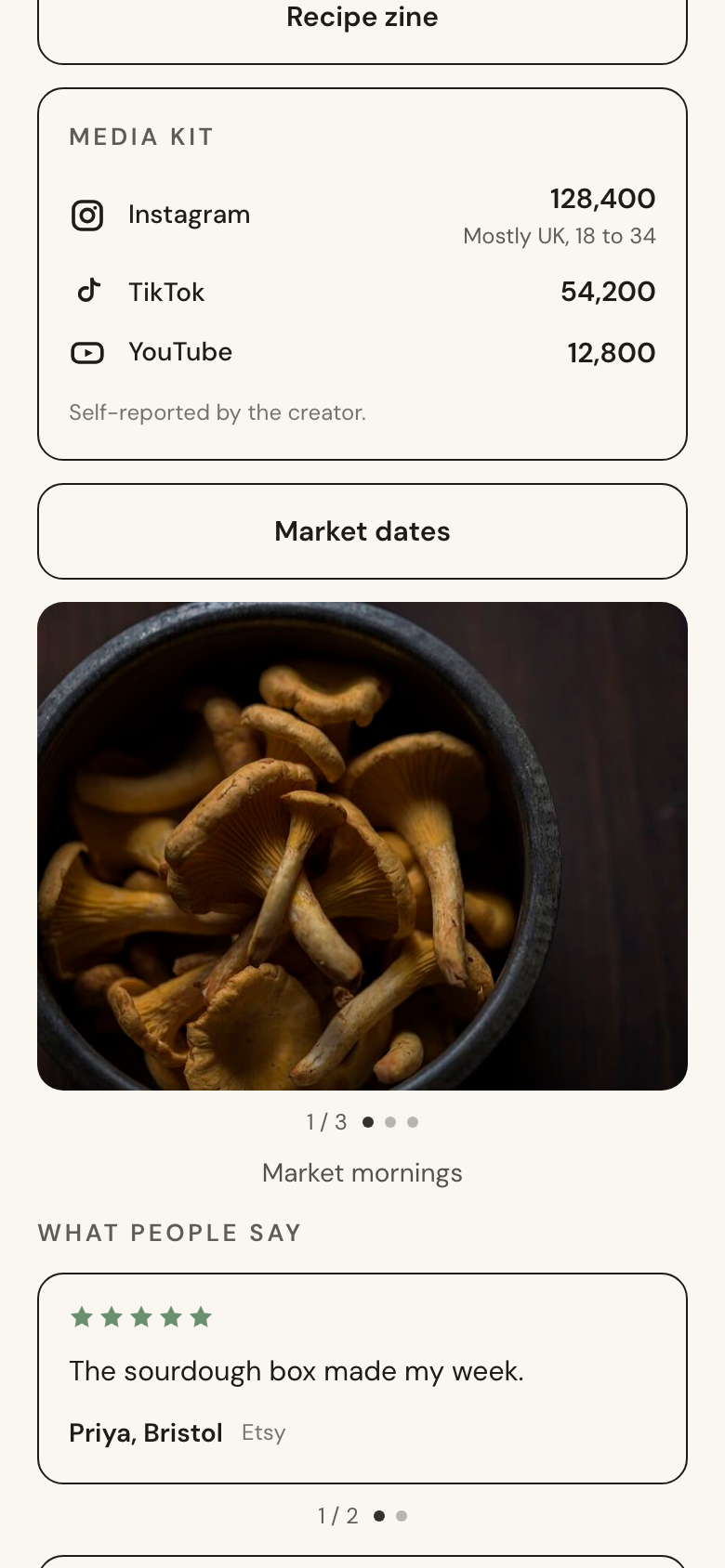
The fix is a media kit that lives on a page and updates itself. That's a big part of why we built Buzzzlinks: connect Instagram, TikTok and YouTube once, and the media kit block on your page shows current followers, audience and recent posts every time a brand opens it, next to reports from campaigns you've already run. Whether you use it or not, the rule stands: a brand should never have to ask which week your numbers are from.
The checklist
- Two-line bio and a photo
- Follower counts per platform you'd deliver on, each with a date
- Views per post, engagement rate with the formula written out, best recent post
- Top countries, age range, gender split, one line of interpretation
- Two to four past collaborations with a real result each
- Formats you sell, what's included by default, usage and exclusivity priced per brief
- "Starting at" rates
- One email and a link to a live page
- Nothing older than 30 days
Do that and you're already ahead of most of the kits landing in that brand manager's inbox this week.